
THE CHALLENGE: Why I Created Franchise Your Knowlege™
I have known a lot of experts.
Brilliant people.
Decades of experience.
Deep expertise.
But when they tried to explain what they knew, their knowledge didn’t land.
Not because they lacked intelligence.
Not because they lacked experience.
But because that knowledge was never designed by a system that made is easy to be understood.
After spending years studying how people learn, how ideas are structured, and how communication works, I began to see a pattern.
When knowledge is designed the way the brain actually processes information, something remarkable happens.
Understanding transfers.
This system draws on research from cognitive science, instructional design, and communication theory.
That insight led to the development of Franchise Your Knowledge™—a system that aligns learning, structure, and communication so knowledge actually works.
When Brain, Skeleton, and Muscles work together, knowledge stops sitting in someone’s head and starts working in the real world.
Knowing Something and Sharing It Are Two Very Different Things
That’s when something important clicked.
These people weren’t struggling because they lacked knowledge.
They were struggling because their knowledge had never been designed to travel from one mind to another.
And that requires a completely different skill.
Knowing something and sharing it are two very different things.
In fact, sometimes the more you know something, the harder it is for you to explain it. There is a technical term for it. It’s called the Curse of Knowledge.
One person described it this way:
“The worst physics professor I ever learned from was the best physicist at my school. An incredibly kind man, brilliant, patient, and always encouraging, but he just could not imagine the thought process of a person who was not already an expert physicist.”
Research in behavioral economics and psychology shows that experts often underestimate how hard their knowledge is for beginners to understand (Camerer, Loewenstein, & Weber, 1989).
It happens when you know something so well that you can no longer easily imagine what it feels like not to know it.
My simpler definition is this:
You’re brilliant, but you can’t share your brilliance.
Your knowledge never compounds because it never fully lands inside someone else’s head.
It sits there like a pile of loose papers—valuable, but impossible to hand to someone else.
Not because the expertise isn’t there—
but because there is no system for sharing it.
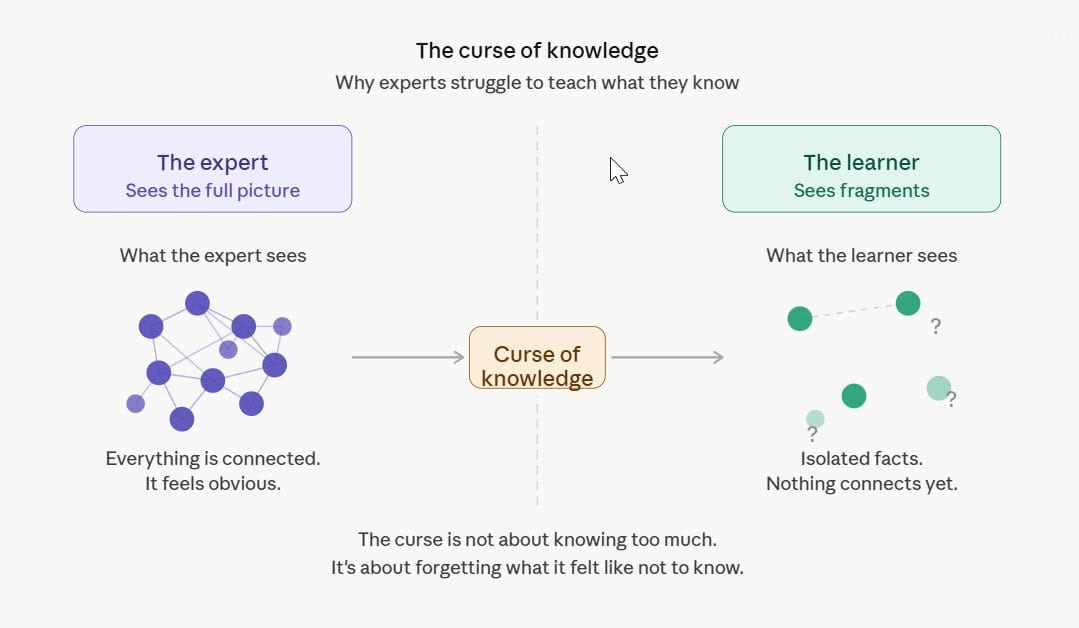
Why This Matters Now: Profiting in the AI Knowledge Economy
There has never been a time in human history when more people could create value from what they know.
Technology has made it possible for knowledge to travel farther and faster than ever before.
But to understand what’s changed, you have to see the pattern.
Every Age Has Its Multiplier
What multiplies human capability?
The Great Multipliers of History
Agricultural age

Animals multiplied effort.
Industrial age

Machines multiplied output.
AI Knowledge economy

Knowledge (designed) multiplies results.
Knowledge alone doesn’t multiply results. Designed Knowledge does.
Knowledge itself is no longer scarce.
Access is no longer the advantage.
The bottleneck today is understanding—knowing how to structure and share knowledge so it actually works for other people.
In a world of podcasts, books, short-form content, YouTube channels, courses, and AI-generated information, value no longer comes from producing more knowledge.
It comes from producing knowledge that works and transfers—in the brain and in the real world.
Poorly designed knowledge leaks.
Well-designed knowledge compounds.
This is the Age of Abundance
The opportunities available today are historically unprecedented.
Entrepreneur and futurist Peter Diamandis, M.D., has pointed out that over the last century, humanity has experienced extraordinary progress.
- Human lifespan has more than doubled.
- Global income per person has increased dramatically.
- Childhood mortality has fallen sharply.
- Global literacy has risen from roughly 25% to more than 80%.
Billions of people now carry more information in their pockets than anyone in history ever had access to.
We truly are living in an extraordinary time.
More people are connected, equipped, and capable of creating value from what they know than at any point in human history.
This is what the knowledge economy has made possible.
But something else has changed.
AI Produces Information. Humans Need Understanding
Yes, we are in the Knowledge Economy.
And now we have AI.
The supply of information is exploding.
But AI does not solve the real problem.
In many ways, it makes it worse.
We don’t need more information.
We are flooded with it.
We need Understanding.
As information increases, the real advantage shifts.
Not to those who know more—
but to those who create clarity, structure, and usability. Because in a world flooded with information,
Knowledge Systems become more valuable—not less.
Why Most Knowledge Fails
And How to Fix It: Built Like a Body™
Not because people aren’t smart.
Not because there isn’t enough information.
But because knowledge is rarely designed to work.
It’s scattered.
Unstructured.
Difficult to use.
It isn’t built for the brain.
It isn’t structured clearly.
It isn’t communicated to transfer.So it doesn’t move.
And if it doesn’t move, it doesn’t work.
BRAIN

HOW SMART PEOPLE LEARN
SKELETON

HOW SMART PEOPLE BUILD
MUSCLES

HOW SMART PEOPLE COMMUNICATE
Knowledge That Works is Built Like a Body™
That insight led to something simple:
Knowledge that works is built like a body.
It became the foundation of Built Like a Body™—a system for designing knowledge that actually works.
Maybe you have never had anyone tell you:
“Your course is failing because it is missing a brain.” Or
“Your program needs a skeleton.” Or
“You have knowledge, but no muscles.”
Well, that is the language we use around here.
Most approaches to teaching and sharing knowledge rely on one strength to do all the work.
- Brain alone → it’s processed, but it doesn’t stick
- Structure alone → it’s arranged, but it’s not a system
- Communication alone → it’s heard, but it doesn’t engage
Knowledge only works when it is built as a whole system.
Built Like a Body™ treats knowledge as a whole system—made up of three interdependent parts.
Each part has a role.
None works alone.
That is the idea behind Built Like a Body™
The Three Parts of the System
When Brain, Skeleton, and Muscles align, knowledge stops sitting in someone’s head and starts working in the real world.

Who Succeeds in the AI Knowledge Economy? The Triple E’s: Expert · Educator · Entrepreneur
Succeeding in the knowledge economy requires more than expertise.
Three roles have converged.
Expert · Educator · Entrepreneur
If you want your knowledge to have an impact today, it isn’t enough to simply know your subject well.
The modern knowledge creator is expected to be all three at once.
Many brilliant people struggle in the knowledge economy not because they lack knowledge—but because they lack a system for turning knowledge into something others can understand and use.
That is exactly the problem Built Like a Body™ solves. It teaches you all three roles.
How You Can Use the System
Built Like a Body™ isn’t tied to a single format or platform.
It applies anywhere knowledge needs to land, hold, and be used.
You can use the system whether you’re creating a course, writing a book, producing a podcast, or teaching through YouTube videos. The same principles apply when you’re designing workshops, delivering keynotes, building curriculum, or developing training programs inside organizations.
It works just as well for shaping years of experience into thought leadership, organizing insight into guides or playbooks, clarifying frameworks for coaching or mentoring, or structuring content inside memberships and learning communities.
What This System Makes Possible
Built Like a Body™ is not just a course. It’s a system.
It’s an operating system for the knowledge economy.
When Brain, Skeleton, and Muscles align:
That’s what it means to Franchise Your Knowledge™.
What This is Really About
This system exists for one reason:
To help smart people stop working against themselves—
and start building knowledge others can actually use.
If what you know makes sense to you, but isn’t landing with others.
You don’t need more effort.
You need the right system.