
ABOUT TAMELA LEWIS
The Day Everything Stopped
I was filming a pilot on entrepreneurship — teaching others how to build a business with what they know — when a young woman, phone in hand, hit me with her car in a mall parking lot.
I was buying makeup for the shoot.
I hit the hood, fell back onto the pavement, struck my head, and that is the last thing I remember.
I woke up in a hospital with doctors assuring my family there would be a full recovery. For a year, I mended — slowly, incrementally, invisibly — piecing my brain, my life, and my business back together one small piece at a time.
That year became everything.
What I Lost — and What It Taught Me
I had always been able to whip my car between two parked cars without thinking. After the accident that was gone. Standing in a parking lot, intimidated by geometry I had performed a thousand times automatically, I understood for the first time what the brain actually does.
It does everything. Invisibly. Until it can’t.
I was living in a family member’s home — mine was rented out — and nothing was where I expected it. The silverware. The towels. Every room arranged differently. In my own home, nothing required thought. Here everything did. Structure is what makes knowledge automatic. Without it, nothing flows. Everything requires effort. Your learners feel this every time they enter a course with no skeleton holding it together.
I had always been a runner — for the wide open spaces, the fluid motion, the way insights would come to me mid-stride that never came sitting still. The accident took that too. And what I didn’t expect was how perfectly it mirrored what happened to my communication.
I had spent my career teaching, speaking, reaching toward others with language as fluid and natural as a morning run. Then it stopped. Like a runner suddenly grounded, the ability began to atrophy. Muscles weaken without use — whether they’re in your legs or in the part of you that reaches toward another person with words.
So I started walking. Then walking further. Then running again.
And I started talking. Then talking more. Then teaching again.
By the end of the year both had come back — fully, completely. Rebuilt through proven strategies — metaphors, comparisons, techniques refined across thirty years and the most demanding organizations in the country. Stronger for having been broken and rebuilt consciously.
My body was rebuilding itself on three systems. The brain relearning how to process and retrieve — node by node, cue by cue, until the network was whole again. The skeleton — battered from hitting the pavement — restoring the structure that had made movement automatic. The muscles — rebuilt through incremental effort and deliberate strategy until strength and fluency returned.
Knowledge rebuilds the same way. Learns the same way. Fails the same way.
Brain. Skeleton. Muscles.
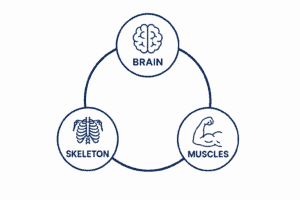
Three systems that must work together. I hadn’t invented a framework. I had lived one. My own recovery was the methodology. I was the proof of concept.

The Background That Made the Metaphor Inevitable
Here’s what I haven’t told you yet.
Before that parking lot. Before the accident. Before the year of rebuilding.
I had spent my entire career living at the intersection of two worlds most people choose between.
One foot in the classroom. One foot in the boardroom. Never choosing. Always both.
I hold three degrees — a bachelor’s in speech, a master’s in communication, and a master’s in education and psychology from the Harvard Graduate School of Education. HGSE is where the research on human learning lives. Where cognitive science meets pedagogy. Where the question isn’t just what to teach — but how the brain actually receives, encodes, and retrieves what it’s taught.
As seen in:
I wasn’t just studying communication. I was studying the architecture of how knowledge moves from one mind into another. I simply didn’t have a name for it yet.
At the same time, I was teaching — adjunct faculty for years, working across communication disciplines. Interpersonal communication. Intercultural communication. Organizational communication. And a dozen more disciplines spanning every dimension of how humans exchange meaning. Every course a different audience. Every audience a different set of filters, vocabulary, and ways of seeing. I learned early that what you know means nothing if you can’t translate it for the specific human being sitting in front of you.
And simultaneously — always simultaneously — I was in the field.
Ford. IBM. Kellogg’s. Kinkos. M&Ms. Southwest Airlines. Verizon. The VA. The US Department of Energy. The Small Business Administration. Sandia National Laboratories. Organizations spanning private sector, government, defense, and industry. Audiences ranging from frontline workers to senior executives. And not just across industries — across cultures. Domestic and international. Every audience arriving with its own language, its own filters, its own way of making meaning.
Clients Include:
What research said and what actually worked — I was testing both. Every day. In real classrooms and real boardrooms simultaneously. Across cultures, industries, and every level of organizational leadership.
That’s not a resume. That’s forty years of field research.
And it produced one conclusion that never changed regardless of the audience, the industry, or the culture:
Knowledge doesn’t fail because the expert lacks expertise. It fails because the knowledge has no system. No brain architecture to make it stick. No skeleton to give it structure. No proven strategies to move it from one mind into another.
The methodology was already there. Built from decades of research and practice, classroom and boardroom, domestic audiences and international ones.
The accident just showed me what it looked like from the inside.

What the Year Gave Me
My faith had always been bedrock — both background and foreground, the central tenet of my life. The accident didn’t give me faith. It stripped away everything else until faith was all that remained. And what remained was enough.
You can have everything except what matters. And not realize it — until everything else is gone.
What I would not trade is the foundation my life is built on — my faith. Because when everything else is gone, that stands. Immovable. Eternal. Everlasting.
That decision — that everything I know must count for others — became Bank Your Knowledge. That metaphor became Built Like a Body. That year became this.
What you know only matters if it helps others.
That belief was shaped through a life-altering experience — and grounded in a faith that continues to guide this work today.
If you have expertise worth sharing — and you do — Built Like a Body™ gives you the system to share it in a way that actually works.